

 NEVADA STATE - Long before the silver mines were tapped or the neon lights of Las Vegas flickered to life, the Great Basin was home to resilient, highly specialized societies. In Nevada, the "colonial conquest" took a different shape than it did on the lush coastlines of the Pacific Northwest. Here, survival depended on an intimate, scientific knowledge of a vast, arid landscape.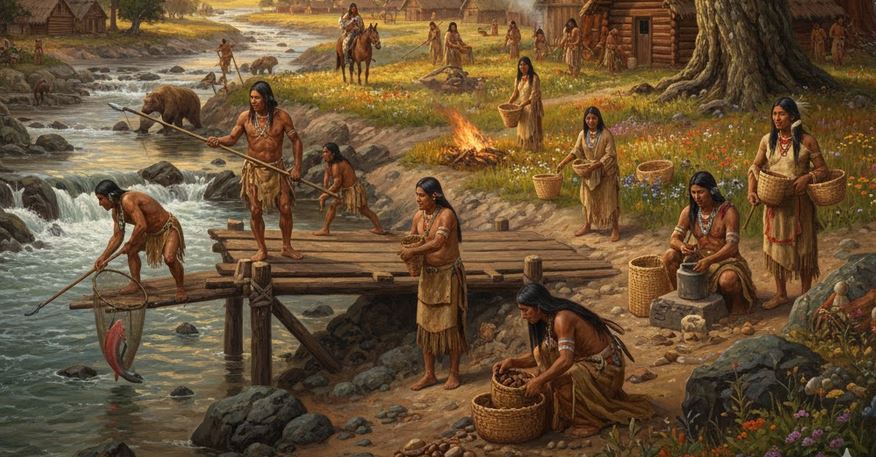
Estimating the pre-contact population of Nevada is notoriously difficult. Because the Great Basin tribes were often mobile—moving with the seasons to harvest pinyon nuts or hunt bighorn sheep—early colonial explorers frequently underestimated their numbers, seeing only small groups and assuming the rest of the land was empty.
Life in the High Desert
The indigenous peoples of Nevada did not live in the dense, permanent urban centers found along the Columbia River. Instead, they lived in a "seasonal round," moving between valley floors and mountain ranges.
The Population Estimates
Because of the lower carrying capacity of the desert compared to the salmon-rich Northwest, the population density was much lower, but still significant:
- The Range: Anthropologists generally estimate the pre-contact population of present-day Nevada to be between 20,000 and 40,000.
- The Dynamics: While these numbers appear smaller than those of Oregon or Washington, they represent a very high density for a desert environment, achieved through sophisticated land management and water conservation.
The Four Sovereign Nations
The indigenous landscape of Nevada was primarily defined by four distinct groups, each with a unique relationship to the state’s varied geography:
- The Wašiw (Washoe), centered around Lake Tahoe (Da ow), were a distinct linguistic group whose territory straddled the Sierra Nevada.
- The Numu (Northern Paiute) inhabited the vast northwestern reaches of the state, including the sacred Pyramid Lake.
- The Newe (Western Shoshone): Inhabiting the central and northeastern plateaus, they are part of one of the largest linguistic groups in the West.
- The Nuwuvi (Southern Paiute): They managed the southern Mojave Desert regions, utilizing springs and irrigation to survive in some of the hottest terrain in North America.
The Invisible Toll: Disease and Resource Loss
Nevada’s population did not decline solely due to direct conflict; it also suffered from a "silent" conquest of resources and health.
- Early Pathogens: Unlike the coastal tribes who met explorers in the 1770s, many Nevada tribes did not have direct contact with Europeans until the 1820s and 1830s. However, diseases often arrived via trade networks from the coast, weakening populations before a single settler arrived.
- The Pinyon Crisis: The colonial arrival wasn't just about land; it was about wood. As silver mining boomed in the mid-1800s, settlers cleared millions of acres of pinyon pine forests to fuel smelters. For the Paiute and Shoshone, the pinyon nut was a primary food staple. This environmental destruction led to widespread starvation, further thinning the population.
Note on Persistence: By the late 1800s, the indigenous population had plummeted, but the people never left. They transitioned from traditional harvesting to working on ranches and in mining towns, maintaining their communities under extreme pressure.
Nevada’s Indigenous Presence Today
Today, the indigenous footprint in Nevada is stronger than ever. There are 20 federally recognized tribes comprised of 27 separate reservations, bands, and colonies. From the high-tech solar projects of the Moapa Band of Paiutes to the water rights victories of the Pyramid Lake Paiute Tribe, Nevada’s first people continue to be the primary stewards of the Great Basin.
