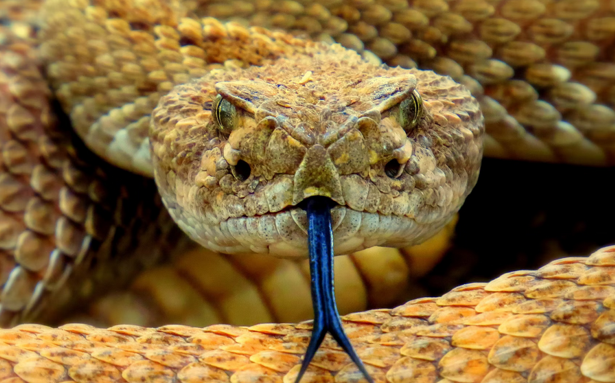
 But for outdoor enthusiasts, the rule is simple: if it’s venomous in California, it’s almost certainly a rattlesnake. While a rare Yellow-bellied Sea Snake might occasionally wash ashore during El Niño years (making headlines when they do), hikers need to keep their eyes on the trail, not the ocean. California is home to roughly seven distinct species of rattlesnakes. From the aggressive giants of the south to the neurotoxic nightmares of the Mojave, here is the definitive guide to the venomous snakes you need to respect.
1. The Mojave Rattlesnake (Crotalus scutulatus)
- Danger Level: Critical (The most toxic snake in the USA)
- Where they hide: The High Desert (Mojave), Antelope Valley, and Kern County.
Often called the "Mojave Green" due to its greenish hue, this is the snake you really don't want to meet. Its venom is a potent "Mojave toxin"—a cocktail of neurotoxins (attacking the nerves) and hemotoxins (attacking the blood). Bites can lead to respiratory failure.
-
ID Tip: Look for the tail banding. The white bands on the tail are significantly wider than the black bands. (Think: "White implies light/fright").
2. The Western Diamondback (Crotalus atrox)
- Danger Level: Very High (Large, aggressive, high venom yield)
- Where they hide: Extreme Southern California (Imperial and Riverside counties), largely in the Sonoran Desert.
The classic "movie rattlesnake." They are large, heavy-bodied, and notoriously defensive. Unlike some shy species, the Western Diamondback will often stand its ground and rattle furiously.
-
ID Tip: Distinct black and white "coon tail" bands that are roughly equal in width.
3. The Southern Pacific Rattlesnake (Crotalus oreganus helleri)
- Danger Level: High (Responsible for most bites in SoCal)
- Where they hide: Coastal Southern California (Los Angeles, San Diego, Santa Barbara) up into the mountains.
If you are hiking Runyon Canyon or Mission Trails, this is the local resident. They are increasingly common in suburban backyards and parks. Recent studies suggest their venom might be evolving to be more potent.
-
ID Tip: Dark brown or black diamond-shaped blotches on a tan or grey body. The tail bands are dark and often blend into the body color (no stark black/white stripes like the Diamondback).
4. The Northern Pacific Rattlesnake (Crotalus oreganus oreganus)
- Danger Level: High
- Where they hide: Central and Northern California (Bay Area, Sacramento, Sierra Nevada foothills).
The primary venomous snake of Northern California. They are often found sunning themselves on trails in open grasslands or oak woodlands.
-
ID Tip: Similar to their Southern cousin, they have dark blotches on a lighter background. The final bands on the tail are usually dark and not well-defined.
5. The Red Diamond Rattlesnake (Crotalus ruber)
- Danger Level: High (but generally docile)
- Where they hide: San Diego County and southwestern Riverside County (Coastal sage scrub).
A stunningly beautiful snake, the Red Diamond is a Species of Special Concern. They are large but typically much calmer than the Western Diamondback.
-
ID Tip: A reddish, brick-colored body with faint white diamonds.
6. The Sidewinder (Crotalus cerastes)
- Danger Level: Moderate
- Where they hide: Sandy desert flats (Mojave and Colorado Deserts).
Famous for their unique sideways movement to traverse loose sand without sinking. A recent incident in October 2025 saw a kindergartener bitten by one of these in Palm Desert, proving they can be found near human settlements.
-
ID Tip: Small size and distinct "horns" (scales) above their eyes.
7. The Speckled Rattlesnake (Crotalus mitchellii)
- Danger Level: High
- Where they hide: Rocky canyons and granite outcrops in the deserts.
The master of disguise. These snakes can vary wildly in color—from pink to grey to white—to match the specific rocks they live on.
-
ID Tip: A "salt and pepper" speckled appearance that breaks up their outline against granite.
The Imposter: The Gopher Snake
Myth: "I saw a rattlesnake, but it didn't have a rattle!" Fact: You likely saw a Gopher Snake.
These harmless snakes are Academy Award-winning actors. When threatened, they hiss loudly, flatten their heads to look triangular, and shake their tails in dry leaves to mimic a rattle sound.
-
The Difference: Gopher snakes have round pupils (rattlesnakes have vertical "cat" slits) and lack the heat-sensing pits on the face.
Safety & First Aid
California hospitals are well-equipped to handle snakebites, but you must act fast.
THE DON'TS:
- NO Tourniquets or Ice.
- NO Cutting and sucking (The "cowboy cure" causes infection and tissue damage).
- NO Trying to kill the snake (This is how most men get bitten).
THE DO'S:
- Call 911.
- Stay Calm.
- Remove Constriction. Take off rings and watches immediately.
- Keep the limb neutral.
Stay safe, watch your step, and enjoy the Golden State’s wild beauty!
Video: Rattlesnake vs. Gopher Snake Identification A guide to telling the difference between the harmless mimic and the real deal.