 IDAHO STATE - Before the boundary lines of the Idaho Territory were drawn in 1863, the region was a vast intersection of cultures. Idaho’s geography—defined by the jagged Rocky Mountains, the deep canyons of the Snake River, and the lush prairies of the north—created a home for some of the most specialized and geographically widespread nations in the West.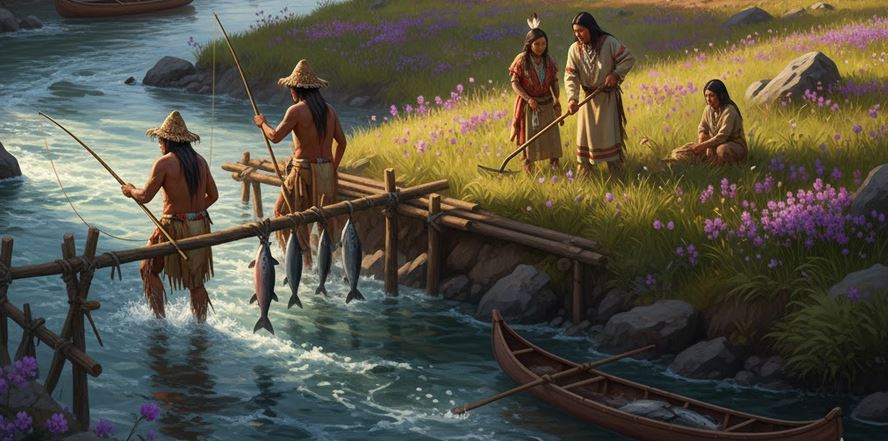
Because much of Idaho’s indigenous population was semi-sedentary—moving between permanent winter villages and seasonal summer camps—calculating a pre-contact population requires looking at the "carrying capacity" of the river systems and the high-altitude plateaus.
A Land of High-Altitude Abundance
Unlike the arid Great Basin to the south, much of Idaho was blessed with "water wealth." The salmon runs of the Snake and Salmon Rivers provided a stable, high-calorie food source that supported larger populations than those in the neighboring desert regions.
The Population Estimates
Historians generally agree that Idaho was more densely populated than Nevada or Utah, but less so than the coastal regions of Oregon and Washington.
- The Estimate Range: Most scholars place the pre-contact population of what is now Idaho between 30,000 and 60,000 people.
- The River Factor: Population density was highest along the Snake and Clearwater River corridors, where the seasonal salmon harvest could support thousands of people in a single location.
The Sovereign Nations of the Mountains and Plains
Pre-colonial Idaho was dominated by two major linguistic and cultural groups: the Sahaptin-speaking peoples of the north and the Shoshone-Bannock peoples of the south.
The Nez Perce (Nimiipuu)
The Nez Perce occupied a vast territory in north-central Idaho. They were one of the most powerful and populous tribes in the Northwest, with an estimated pre-contact population of 10,000 to 15,000. They lived in large, permanent villages along the rivers and became world-renowned for their horse-breeding programs, specifically the Appaloosa.
The Shoshone and Bannock
The southern half of the state was home to the Shoshone and the Bannock (a Northern Paiute group that moved into the region). These groups were highly mobile, utilizing the "seasonal round" to hunt buffalo on the eastern plains and harvest camas bulbs in the mountain meadows.
The Coeur d’Alene (Schitsu'umsh) and Kootenai (Ktunaxa)
In the panhandle, the Coeur d'Alene and Kootenai tribes lived around the great lakes and rivers of the north. Their lives were centered on the water, using distinctive sturgeon-nosed canoes perfectly adapted for navigating the region's marshes and rivers.
The Biological Frontier and the Horse
Idaho’s population underwent a massive shift in the 1700s, nearly a century before the first permanent white settlements were established.
- The Arrival of the Horse (c. 1730): The introduction of the horse via southern trade routes transformed Idaho’s tribes. It allowed groups such as the Nez Perce and Shoshone to travel farther and hunt more effectively, but it also increased intertribal conflict and concentrated populations in ways that made them more vulnerable to disease.
- The Smallpox Waves: Historians believe that a massive smallpox epidemic swept through the Rockies in the 1780s, likely killing a significant percentage of Idaho’s indigenous population before they ever saw a European explorer.
Idaho’s Indigenous Presence Today
The 19th-century "conquest" of Idaho was marked by some of the most famous resistance movements in American history, including the Nez Perce Flight of 1877. Despite the forced contraction of their lands, the tribes of Idaho remain central to the state’s identity.
 Today, there are five federally recognized tribes in Idaho: the Nez Perce, the Shoshone-Bannock, the Coeur d'Alene, the Kootenai, and the Shoshone-Paiute. These nations are leaders in environmental conservation, particularly in the effort to save the Snake River salmon—a resource that has sustained the people of this land for over 10,000 years.